
From Hardware Validation to SDV: The Hidden Sequencing Behind BYD's Latest Test
An analysis of the balance between hardware excellence and the shift toward Software-Defined Vehicles in the bus sector, illustrated through the case of BYD.
INDUSTRY NEWS
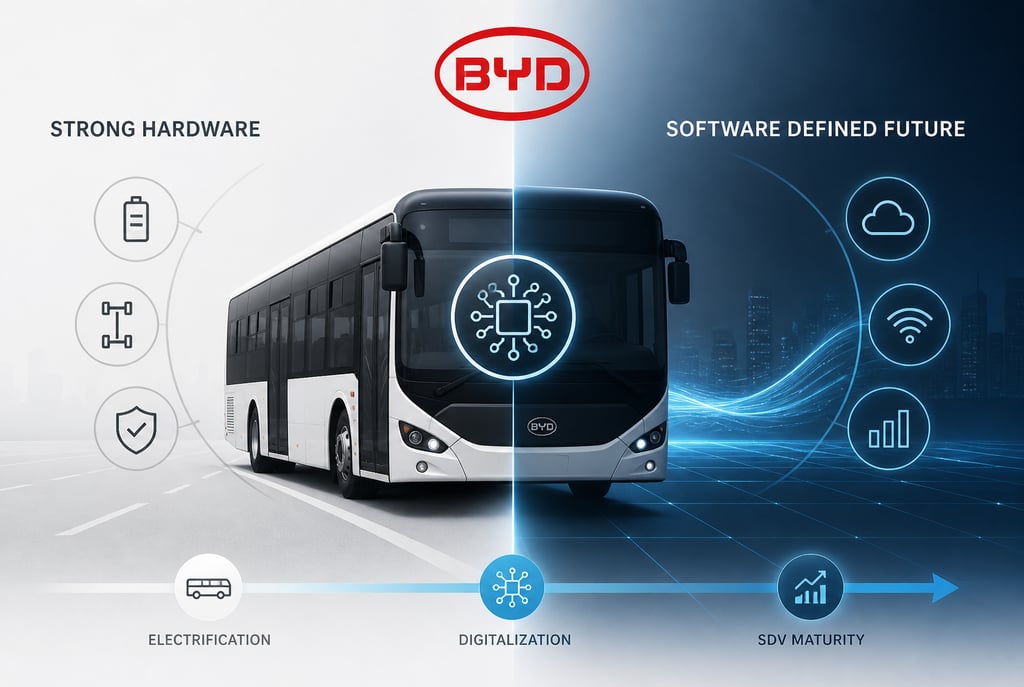
BYD recently drove an electric bus from Melbourne to Sydney and back : 2,200 km, two charges, zero mechanical incidents. The Australian trade press praised the performance. European operators noted the numbers. No one asked the one question that matters.
In Tarcutta, the only charging point on the outbound journey, the driver parked the BC12B1 next to a standard car charger and manually adjusted the distance so the connector could reach the bus. No OCPP. No ISO 15118. No smart charging session. A 382 kWh bus plugged in like a Renault Zoe.
In 2026, a manufacturer whose Xuanji architecture integrates onboard AI, a central processor, a 5G network, and an Internet of Vehicles across its passenger cars is delivering buses that are manually charged on car chargers at Australian gas stations.
The thesis: BYD is not yet selling SDV buses, it is selling SDV-compatible chassis, and the difference is not a technical nuance. It is a contractual clause that most operators haven’t read.
SIGNAL CARDS
382 kWh : 0.8 kWh/km in highway conditions, HVAC active, no regeneration
The BC12B1 consumes 30–40% less than a conventional urban bus in mixed cycles. This validates the hardware. It says nothing about the vehicle’s ability to optimize its own consumption through a software layer. A bus that consumes efficiently without embedded intelligence is an efficient diesel engine not an SDV.
BYD’s hardware is excellent. The absence of visible software in this test is not an oversight.
10 years / 3,300 cycles at >80% capacity : BC12B1 battery warranty
BYD is the only bus manufacturer offering this warranty. It protects operators against physical battery degradation. It guarantees nothing regarding software updates, OTA feature activation, or access to telemetry data. Two different guarantees, two different conversations at contract signature.
Battery warranty is a commercial argument. Software governance is a separate contractual issue.
Transit Systems Australia commissioned the test not BYD
The operator wanted to validate its depot charging infrastructure before fleet delivery. It defined the test scope, not the manufacturer. This detail flips the usual interpretation: BYD is not demonstrating its SDV roadmap. It is responding to a client’s hardware validation requirement. The software layer was not part of the agenda because no one requested it.
In the bus sector, operators control the pace of SDV transition not manufacturers.
TECHNICAL MECHANICS
Why Xuanji architecture is not in the Australian BC12B1
BYD introduced the Xuanji architecture in January 2024 during Dream Day in Shenzhen. The system integrates a central processor capable of processing internal and external vehicle data at millisecond scale, onboard AI covering over 300 operational scenarios, native 5G connectivity, and a data chain feeding a continuous learning model. This is a fully-fledged intelligent vehicle architecture not an upgraded ECU stack.
The BC12B1 delivered in Australia does not benefit from it. Its E/E topology remains domain-based: subsystems (propulsion, body, comfort, safety) communicate via separate domain controllers over CAN FD buses (2 to 8 Mbps). High-performing and robust, this architecture belongs to the previous generation not the one enabling real-time software optimization, OTA updates on propulsion ECUs, or V2I communication with depots.
The next generation of BYD bus chassis e-Bus Platform 4.0, expected around 2027–2028 should integrate a zonal architecture with front/middle/rear zone controllers, reducing wiring by 30–40% (15–25 kg of copper per vehicle) and enabling OTA updates on critical systems. This is not the chassis operators are buying today.
Charging protocol as an architectural signal
Charging on a car charger in Tarcutta is not anecdotal. It reveals the absence of two standards that define the software layer of vehicle–infrastructure interaction.
ISO 15118 (“Plug & Charge” communication) allows the bus to authenticate automatically, negotiate charging power based on BMS status, and communicate its state of charge to the operator’s TMS. Without it, the bus is a passive energy recipient.
OCPP 2.0.1 (Open Charge Point Protocol) enables the charger to integrate into a depot energy management system, schedule charging sessions based on service planning (GTFS), and report data to the operator’s back office. Without OCPP, each charge is an isolated, non-trackable, non-optimizable event.
Together, these two protocols form the minimum viable layer for an electric bus to operate within an SDV energy logic. Their absence in the Australian test means the full system (vehicle + infrastructure + software) was not in place. Only the vehicle was.
WHAT THE SPEC DOESN’T SAY
UN R156 requires OEMs to implement a SUMS (Software Update Management System) for vehicles capable of receiving updates.
It does not define which functions must be activated, nor within what timeframe after delivery.
A bus certified under R156 can legally receive no substantial updates for 5 years.
Regulatory compliance and SDV maturity are orthogonal measures.
FIELD
BYD / Transit Systems Australia Melbourne, 2026
Transit Systems Australia is deploying a new generation of BYD electric buses. Before delivery, the operator required validation of the BC12B1 under its own constraints: depot charging infrastructure, battery behavior under extreme heat, and real-world consumption outside urban cycles.
→ The real problem: Potential incompatibility between chassis charging specifications and installed chargers. On a fleet of 168 buses, a 30-minute deviation per charging cycle equals 84 hours of lost operational capacity each night, roughly €50,000 in daily lost revenue at Australian urban network rates.
→ What was done: Real-world test, 2,200 km, charging on available infrastructure (≤22 kW AC). Documentation of BMS behavior, thermal cycles at 38°C, and consumption at 0.8 kWh/km without regeneration.
→ Result: Hardware validated. Consumption below manufacturer expectations. Zero incidents. Infrastructure gap identified: depot chargers must support at least 50 kW DC with OCPP 2.0.1 to meet overnight service windows.
→ What this case doesn’t say: The test validated the vehicle under conditions BYD does not recommend, highway, no regeneration, non-optimized charging. Results are excellent precisely because the scenario was unfavorable. In proper urban cycles with adequate infrastructure, operational gains will be higher. But the test says nothing about software capabilities because they were not in scope. Any operator using this test to assess SDV maturity is looking at the wrong indicator.
Dyson Group / BYD : Melbourne, 2025–2034
Dyson Group is transitioning its North Melbourne depot to zero emissions: 168 BYD electric buses over 9 years, full depot redevelopment, and maintenance team training.
→ The real problem: A converted diesel depot lacks subscribed power capacity, charge management systems, and remote diagnostics protocols. Without them, 168 buses become 168 unmanaged operational complexities.
→ What was done: Deliberate phasing, pilot depot and first buses (2025–2026), fleet ramp-up (2027–2030), software optimization and EMS integration (2031–2034).
→ Intermediate result: Phase 1 underway. Dyson benefits from the 10-year/3,300-cycle battery warranty, the only concrete long-term commitment from BYD.
→ What this case doesn’t say: Software optimization is scheduled for 2031–2034 : 6 to 9 years after first deliveries. This means early bus generations will operate in “enhanced electric” mode for most of their lifecycle, without SDV features the platform was designed for. This is not a failure : it is a deployment choice. But it shows SDV maturity depends more on operator infrastructure investment timelines than on manufacturer capability.
BLIND SPOT
What BYD doesn’t say about its software lead and why it matters
The dominant narrative: BYD leads due to vertical integration of battery, motor, and control systems. This gives it a hardware advantage European manufacturers cannot replicate short-term.
True. And only half the story.
The other half: BYD has Xuanji, onboard AI trained on global fleet data, and cloud infrastructure capable of updating, optimizing, and monitoring each vehicle remotely. This capability exists. It is deployed in passenger cars in China. It is not activated in exported buses.
Why? Two likely reasons.
First, regulatory. UN R155 requires certified cybersecurity management systems for connected vehicles in Europe. Deploying Xuanji on exported buses means full UNECE certification, costing €500,000 to €2M per vehicle type and exposing proprietary architectures to regulatory scrutiny.
Second, strategic. Fleet data (consumption, driver behavior, charging patterns, incidents) is a high-value industrial asset. BYD collects it domestically. On export markets, data governance frameworks are not standardized. Activating Xuanji in Europe raises unresolved data sovereignty issues.
For operators: current BYD contracts typically do not specify which software features will be activated, when, under what license model, or with what data access rights. This contractual gap is the real SDV risk, not hardware maturity.
INDUSTRIAL ROADMAP
BYD : e-Bus Platform 4.0 (2027–2028 horizon)
Zonal architecture replacing domain topology. 30–40% wiring reduction. Deployment conditional on UN R155/R156 certification. Without it, likely limited to China.
Scania : unified E/E architecture (since 2023)
Common truck/bus platform, native R155/R156 compliance, OTA capabilities. Maintenance contracts now include software update commitments.
Solaris : Urbino Electric OTA program (2024–2025)
OTA for BMS firmware, regenerative braking calibration, HVAC parameters. Operators with OCPP 2.0.1 infrastructure reach 94% OTA activation vs 31% for legacy systems.
Bus cybersecurity market : $10.6B by 2035
Driven by expanding attack surface of connected fleets. Cybersecurity will become a significant TCO component by 2028–2030 : currently absent from most business cases.
VERDICT
The article ultimately highlights a broader industry reality: the transition to electric buses is no longer just a question of vehicle performance, but of system integration maturity. True value now depends on the alignment between hardware, software ecosystems, charging infrastructure, and operator capabilities. Many fleets are still operating in a hybrid phase where advanced vehicles are deployed without fully activated digital layers. This creates a gap between electrification and genuine Software-Defined Vehicle adoption. The future competitiveness of the bus industry will be determined less by chassis innovation alone and more by the ability to synchronize infrastructure, data governance, and lifecycle software management at scale.